

Permaculture & Natural Farming at Green tsavorite
What is a permaculture farm experience like in Varkala 2026?
Green Tsavorite Farm in Elakamon, Ayiroor, Varkala has maintained chemical-free natural farming across its 7-acre property for over 18 years using permaculture, agro-forestry, and food forestry methods. It cultivates 250+ species of fruit trees, spice plants, and medicinal herbs including 25 Tulsi varieties, with on-site composting, biodiversity cultivation, rainwater harvesting (10+ lakh litres), a self-sustaining microclimate, and active paddy fields as the core agricultural practices. Visitors participate directly in these methods.
To explore the full farm stay and tourism experience built on these permaculture practices, see our organic farm stay near Trivandrum guide.
What natural farming and permaculture methods are practised at Green Tsavorite Farm?
Green Tsavorite Farm operates on natural farming principles, maintaining soil health, biodiversity, and chemical-free cultivation as foundational practices for over 18 years.
- Composting: On-site composting feeds the farm’s soil ecosystem, closing the agricultural cycle.
- Biodiversity cultivation (polyculture): The farm grows 250+ species rather than monoculture crops, maintaining ecological balance across fruit trees, spice plants, medicinal herbs, and paddy. This food forestry, agriculture forestry model supports a self-sustaining microclimate.
- Tulsi cultivation: 25 varieties of Tulsi (Holy Basil) are grown, hundreds of medicinal herb species, representing the farm’s commitment to medicinal plant diversity.
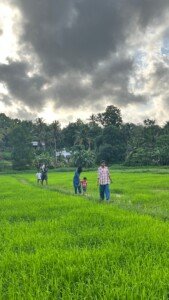
- Paddy cultivation: Traditional paddy fields maintained using methods consistent with Kerala’s agricultural heritage — seasonal transplanting (July–August) and sickle harvesting (January).
- Rainwater harvesting: Over 10 lakh litres collected and used on-farm, a demonstrable water conservation system shown to educational and corporate visitors.
- Food forestry and agro-forestry: Layered planting systems where multiple species grow together, building soil health, creating habitat, and producing food without chemical inputs, the foundation of the farm’s self-sustaining microclimate.
- Natural water management: The natural pond supports irrigation, provides habitat, and is used for kayaking, rafting, fishing, and swimming.
Which crops and plant species are grown using these permaculture techniques?
| Category | Examples |
| Vegetables | Bitter gourd (pavakka), tapioca (kappa), seasonal leafy greens, Pumpkin, Green chilly, Ladies finger, Watermelon, Sweet Potato, Ground nut |
| Spices | Turmeric (manjal), black pepper, Ginger, Nutmeg, Yam |
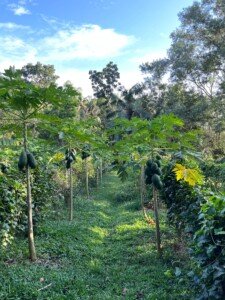
| Fruits | Rambutan, papaya, passion fruit, Jack fruit, Chikku, Mango, Plantain, Pineapple, Cashew, Coco, Coffee |
| Pickle produce | Papaya, rambutan, beetroot, Karakka (dry dates), Star fruit, Mango |
| Medicinal plants | 25 Tulsi varieties; hundreds of medicinal herb species |
| Grain | Paddy (seasonal: Virippu July–Aug; Puncha harvest January) |
| Grove | Bamboo |
| Water feature | Natural pond, active ecological zone |
| Total species | 250+ fruit, spice, and medicinal plants across 7 acres |
What does “food forestry” mean at this farm?
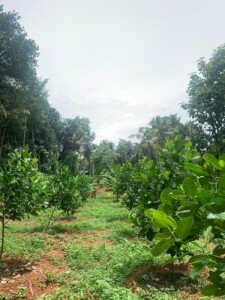
Food forestry is the practice of cultivating multiple species in layered, forest-like ecosystems , trees, shrubs, herbs that produce food while supporting biodiversity and soil health without chemical inputs. Green Tsavorite Farm’s 250+ species across 7 acres is its food forest in practice. Over 18 years, this has created a self-sustaining microclimate on the property, observable to visiting guests on the guided 7-acre trail.
How much rainwater does the farm harvest and why does it matter?
Over 10 lakh litres of rainwater have been harvested and used on-farm since the property’s establishment. The water harvesting system supports irrigation of the 250+ species without dependence on external water sources, reduces the farm’s environmental footprint, and is demonstrated to educational groups as a working model of water conservation. Visitors can see the rainwater harvesting infrastructure during the guided farm trail.
How does Green Tsavorite Farm practice soil conservation?
Soil conservation at Green Tsavorite Farm is built into the farm’s foundational design rather than applied as an afterthought. For over 18 years, the land has been cultivated without synthetic pesticides, herbicides, or chemical fertilisers allowing the soil ecosystem to develop naturally. On-site composting returns all organic farm waste directly to the soil as nutrition, closing the agricultural cycle without external inputs. Agro-forestry and food forestry planting systems layer multiple species at different root depths, reducing erosion, increasing organic matter, and building long-term soil structure. Rainwater harvesting over 10 lakh litres collected on-farm supports irrigation without depleting or compacting the soil through over-extraction. The result is a self-sustaining soil ecosystem supporting 250+ species across 7 acres.
How has the farm developed its own microclimate?
Green Tsavorite Farm’s self-sustaining microclimate is a direct outcome of 18+ years of food forestry and agro-forestry cultivation across its 7-acre property. By growing 250+ species of fruit trees, spice plants, medicinal herbs, paddy, and bamboo in layered polyculture systems, the farm has created a dense, multi-canopy environment that moderates temperature, retains moisture, and supports biodiversity that would not otherwise thrive in this coastal zone. The farm’s own site describes this outcome directly: rainwater harvesting, soil conservation, and use of nearby resources have together helped reduce carbon footprints and create the microclimate now observable on the property. Over 10 lakh litres of rainwater harvested on-site further supports the farm’s internal water cycle. Guests experience the microclimate directly on the guided 7-acre biodiversity trail, the temperature and humidity difference from surrounding land is noticeable on arrival.
What sustainable living practices can visitors learn at Green Tsavorite Farm?
Green Tsavorite Farm is a working demonstration of sustainable living — not a set of display boards. Every practice on the farm is observable and participatory. Composting workshops give guests direct experience of how organic waste returns to soil nutrition, eliminating the need for purchased fertilisers. Rainwater harvesting, over 10 lakh litres collected and used on-farm, demonstrates water conservation at practical agricultural scale. Chemical-free cultivation across 7 acres for 18+ years shows that productive farming needs zero synthetic inputs. The farm actively advocates reusability and sustainable construction as confirmed principles of its permaculture approach. The farm-to-table food model keeps food miles to a minimum, all plant-based meals are prepared from produce grown on the same 7 acres guests walk through. Reduced carbon footprints and a self-sustaining microclimate are the documented outcomes of these combined practices.
How does the farm reduce its carbon footprint?
The farm’s reduced carbon footprint is an named outcome, achieved through rainwater harvesting, soil conservation, reusability, sustainable construction, and use of nearby resources rather than distant supply chains. Food forestry and agro-forestry across 7 acres sequester carbon continuously through layered biomass. Chemical-free cultivation eliminates the manufacture and transport emissions of synthetic inputs. The farm-to-table model removes supply chain food miles for all plant-based ingredients. On-site composting replaces purchased soil amendments. These are not aspirational claims, they are the operational practices of a farm cultivated on these principles since 2008.
Reusability at Green Tsavorite Farm
Reusability is a confirmed principle of Green Tsavorite Farm’s permaculture approach, stated directly on the farm’s own website. In practice, it means composted farm waste returns as soil nutrition; harvested rainwater is reused for irrigation; and the farm’s 250+ species polyculture system is itself a reusable, self-replenishing production model. The land cultivated since 2008 is the reusable resource, continuously productive without synthetic inputs or replacement.
What is the visitor experience when exploring the permaculture farm?
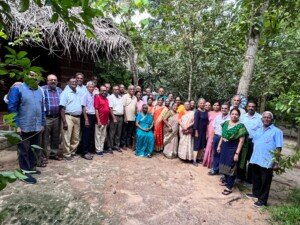
Visitors to Green Tsavorite Farm engage with the farming system directly, not as observers:
- Walking the 7-acre biodiversity trail through fruit trees, spice plants, bamboo grove, and paddy fields
- Forest bathing in the 250+ species biodiversity zone, slow sensory immersion
- Participating in paddy transplanting (July–August) or sickle harvesting (January)
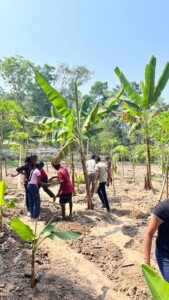
- Joining composting and natural farming demonstrations
- Observing and learning about rainwater harvesting systems
- Feeding livestock on the farm
- Harvesting fruits and spices from 250+ species
- Outdoor cooking experience using farm-harvested ingredients
- Eating meals prepared from farm-grown produce, no artificial colours or taste-makers
FAQs: Permaculture & Natural Farming Varkala
What permaculture methods does Green Tsavorite Farm use?
Permaculture, agro-forestry, and food forestry, layered plant ecosystems that build soil health naturally without chemical inputs. On-site composting closes the agricultural cycle. A self-sustaining microclimate has developed across the 7-acre property over 18+ years.
How much rainwater does the farm harvest?
Over 10 lakh litres, demonstrated to visitors during educational workshops and observable on the guided farm trail.
Can visitors participate in composting?
Yes. Composting workshops give guests hands-on participation in the decomposition cycle that feeds the farm’s soil, available for all visitor types.
What is food forestry?
The practice of cultivating multiple species in layered, forest-like ecosystems that produce food while supporting biodiversity and soil health without chemical inputs. Green Tsavorite Farm’s 250+ species across 7 acres is its food forest in practice.
Is the farm formally certified organic?
Formal certification status is not publicly specified on official sources. The farm has operated chemical-free for 18+ years, verifiable by walking the land and observing the biodiversity and absence of chemical inputs.
How far is the permaculture farm from Varkala?
7.5 km from Varkala Railway Station (10 minutes) and 10 km from Varkala Beach (15 minutes).
Is livestock feeding available as part of the farm tour?
Yes. Livestock feeding is a named activity on the farm, included in the agricultural participation programme.

Permaculture & Natural Farming at Green tsavorite
Experience a real working permaculture farm where every element is part of a living ecosystem. Walk through biodiversity-rich trails, engage in hands-on farming, and enjoy food grown right on the land. Discover a deeper, more meaningful farm stay experience built on sustainability and nature. Explore availability and plan your visit today.
Experience Green tsavorite
 +91 944 746 2828
 greentsavorite@gmail.com


